
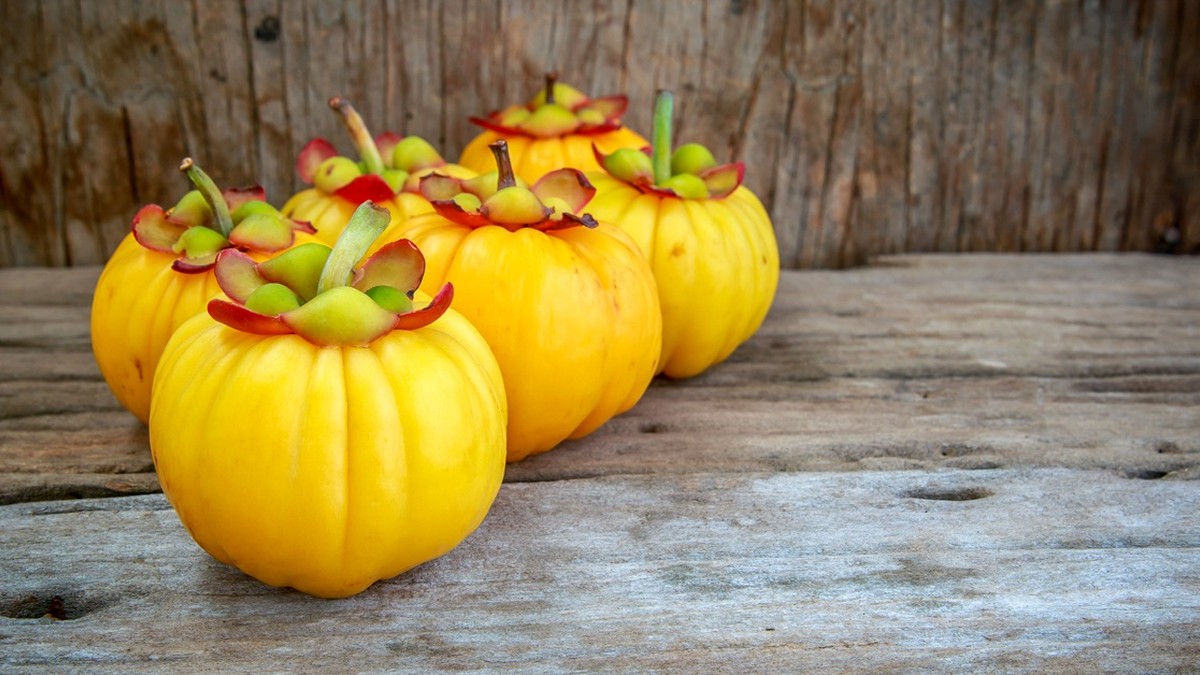
Lets have a look at Garcinia Cambogia nature: where it comes from, what is it and is it natural product or not?
Cultivation
Garcinia gummi-gutta is grown for its fruit in southeast Asia, coastal Karnataka/Kerala, India, and west and central Africa. It thrives in most moist forests.
Garcinia gummi-gutta is one of several closely related Garcinia species from the plant family Guttiferae.[3] With thin skin and deep vertical lobes, the fruit of G. gummi-gutta and related species range from about the size of an orange to that of a grapefruit; G. gummi-gutta looks more like a small yellowish, greenish or sometimes reddish pumpkin.[4] The color can vary considerably. When the rinds are dried and cured in preparation for storage and extraction, they are dark brown or black in color.
Along the west coast of South India, G. gummi-gutta is popularly termed “Malabar tamarind,” and shares culinary uses with the tamarind (Tamarindus indica). The latter is a small and the former a quite large evergreen tree. G. gummi-gutta is also called “goraka” or, in some areas, simply “kattcha puli” (souring fruit).
Uses
Cooking
Garcinia gummi-gutta is used in cooking, including in the preparation of curries. The fruit rind and extracts of Garcinia species are called for in many traditional recipes,[5] and various species of Garcinia are used similarly in food preparation in Assam (India), Thailand, Malaysia, Burma and other Southeast Asian countries. In the Indian Ayurvedic medicine, “sour” flavors are said to activate digestion. The extract and rind of Garcinia gummi-gutta is a curry condiment in India.[citation needed][dubious – discuss] It is an essential souring ingredient in the Southern Thai variant of kaeng som, a sour curry.[citation needed]
Garcinia gummi-gutta is employed commercially in fish curing, especially in Sri Lanka (Colombo curing) and South India, which makes use of the antibacterial qualities of the fruit.[citation needed]
The trees can be found in forested areas and also are protected in plantations otherwise given over to pepper, spice, and coffee production.
Traditional medicine
Aside from its use in food preparation and preservation, extracts of G. gummi-gutta are sometimes used in traditional medicine as purgatives.[citation needed]
Weight loss
In late 2012, a United States television personality, Dr. Oz, promoted Garcinia cambogia extract as a “magic” weight-loss aid. Dr. Oz’s previous endorsements have often led to a substantial increase in consumer interest in the promoted products. However, clinical trials do not support claims that Garcinia cambogia is an effective weight-loss aid.[6] A meta-analysis found a possible small, short-term weight loss effect (under 1 kilogram).[7] However, side effects—namely hepatotoxicity—led to one preparation being withdrawn from the market.[8]
A 1998 randomized controlled trial looked at the effects of hydroxycitric acid, the purported active component in Garcinia gummi-gutta, as a potential antiobesity agent in 135 people. The conclusion from this trial was that “Garcinia cambogia failed to produce significant weight loss and fat mass loss beyond that observed with placebo”.[9]


Source: http://en.wikipedia.org/wiki/Garcinia_cambogia
Garcinia (hydroxycitric acid)
Scientific Name(s): Garcinia cambogia(Gaertn.) Desr. Family: Clusiaceae (Guttiferae)
Common Name(s): Malabar tamarind , hydroxycitric acid ( HCA )
Uses of Garcinia (hydroxycitric acid)
The medical literature primarily documents weight loss and lipid-lowering activity for the plant. However, trials supporting its use are limited.
Garcinia (hydroxycitric acid) Dosing
The dosages of G. cambogia extract in clinical trials ranged from 1,500 to 4,667 mg/day (25 to 78 mg/kg/day). The equivalent hydroxycitric acid (HCA) dose in the trials ranged from 900 to 2,800 mg/day (15 to 47 mg/kg/day). G. cambogia is available in capsule or tablet form with a maximum dose of 1,500 mg/day.
Contraindications
Avoid use if there is a known allergy or hypersensitivity to any components of G. cambogia .
Pregnancy/Lactation
Information regarding safety and efficacy in pregnancy and lactation is lacking.
Garcinia (hydroxycitric acid) Interactions
The herb has documented drug interactions.
Garcinia (hydroxycitric acid) Adverse Reactions
At least 15 clinical studies involving approximately 900 patients document very mild adverse reactions. Most adverse reactions included headache, dizziness, dry mouth, and GI complaints such as nausea and diarrhea.
Source: http://www.drugs.com/npp/garcinia-hydroxycitric-acid.html
Here we can see that there is not enough data to prouve Garcinia Cambogia’s effectiveness, still many people clam that they loose weight taking it.